The books
The club’s books, kept by the same system that billed the flight
Every other club platform bolts onto an accounting package and calls the join "integration". This is the part FlightWay was built around first, and everything else was built on top of it.
What "real books" means here
- Double entry. Every charge, payment, credit, refund, expense and dues run posts a balanced journal entry with a debit and a credit.
- Append only. A posted entry is never edited. A correction is a reversing entry, which is what makes the ledger an audit trail instead of a record of what somebody last thought.
- A chart of accounts, with assets, liabilities, equity, income and expense, so the statements are the ones an accountant expects.
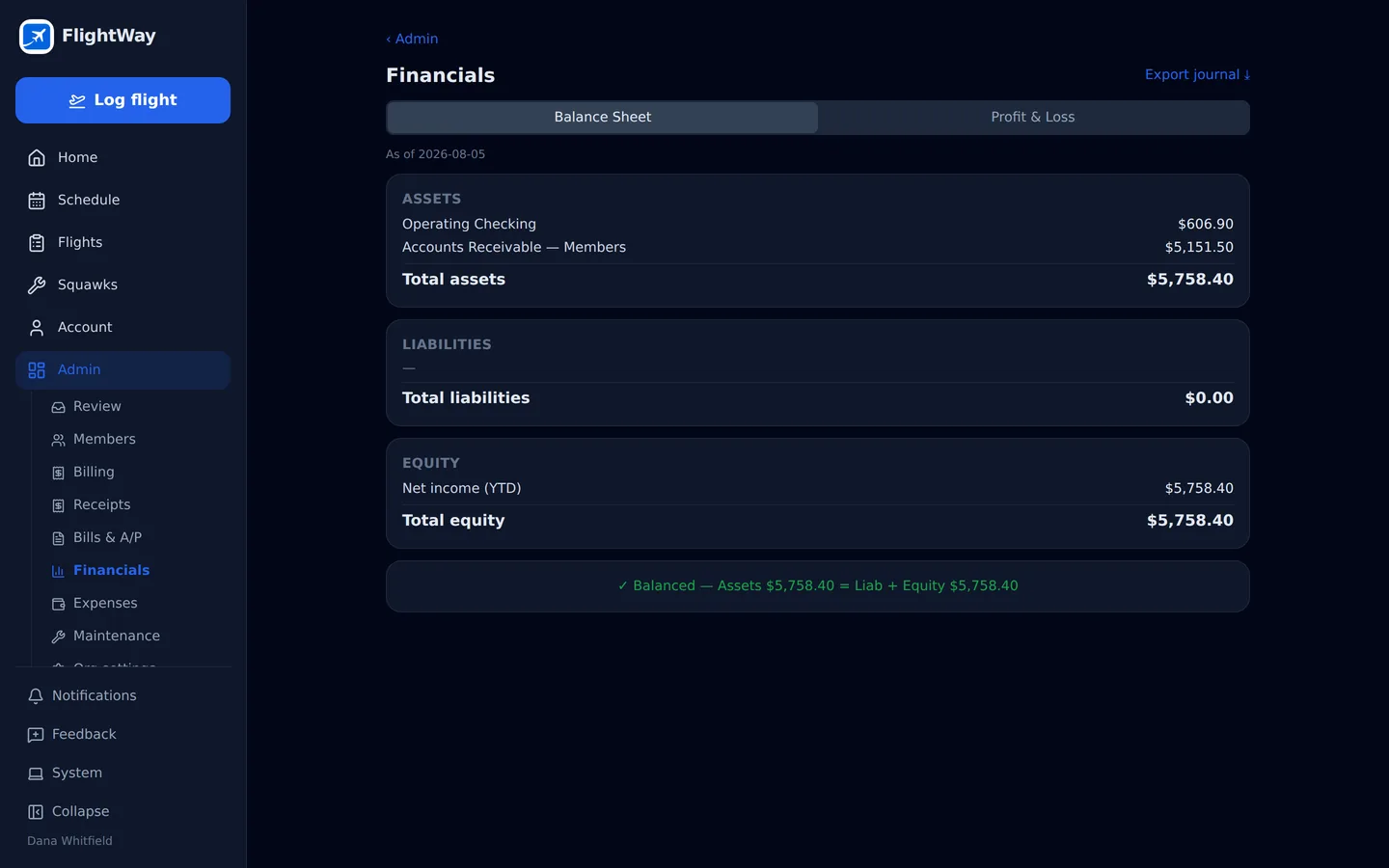
- Statements that are derived, never stored: a balance sheet that proves it balances, a profit and loss, and A/R aging built from the same entries.
- A full journal export, every entry and every line, that any accountant or system can read.
Why a sync is not the same thing
A sync means two systems each hold a version of the truth and a nightly job tries to keep them agreeing. When they disagree, and they do, somebody has to work out which one is right, usually the volunteer treasurer, usually in the week the statements are late.
With the ledger inside, there is no second copy to disagree with. The charge that appeared on the member’s statement is the journal entry the balance sheet is built from. It is the same row.
| Question | With a QuickBooks sync | With FlightWay |
|---|---|---|
| Where did this member balance come from? | Two places, and they must be reconciled | One ledger, derived from the entries you can open |
| A flight was billed at the wrong rate | Fix it twice, hope the sync agrees | Post a reversing entry; the trail shows what happened |
| Month end | Export, import, reconcile, chase | Approve the run; the books are already posted |
| What does the club owe the engine fund? | Whatever the spreadsheet says | An account in the chart, moved by entries |
| Handover to the next treasurer | Two logins, and a folder of workarounds | One system with an auditable history |
The things a club treasurer needs and rarely gets
A/R aging that is true
Who owes what, and for how long, straight from the ledger. Not a spreadsheet updated after the fact.
Expenses and bills
Hangar, insurance, fuel, the annual. Recorded against accounts and, where it matters, against the aircraft they belong to.
Bank reconciliation
Match what the bank shows to what the books show, and see what has not cleared.
Year end
A year-end report and a journal export that the club’s CPA can work from without a translation layer.
Aircraft-level truth
What each aeroplane earned and cost, which is the number a board needs before it changes a rate.
Nothing hidden
Every derived figure can be opened down to the entries that make it up. If a number looks wrong you can find out why.

It has been done for real, not just designed
A full year of an existing club’s QuickBooks history was rebuilt in FlightWay as real journal entries and reconciled to the penny against the old A/R aging before a single member was billed from it. That is the reason the migration page can be specific about what that job involves.
Where the boundary is
This is a club ledger, not a general accounting package. There is no payroll, no sales tax, no bank feed, no budgeting module, and no chart-of-accounts editor to get lost in. If your club needs those, the journal export is the on-ramp to a package that has them, and it stays a first-class feature rather than a checkbox.
Ask the awkward question
If you are the person who would have to reconcile this, ask the thing you actually want to know. You will get a real answer from someone who has done the reconciliation, not a discovery call.
Last updated 18 August 2026.